














Education is undergoing a transformation; teaching today requires adaptability and a willingness to embrace new tools, challenges, and ways of reaching learners. At the heart of this shift is the use of Artificial Intelligence in education. Put simply, this is the use of advanced software, machine learning algorithms, and digital systems that can learn, adapt, and perform tasks such as lesson planning, grading, and personalising student learning.
For teachers and students in the classroom today, Artificial Intelligence is not a replacement for human connection, but it undoubtedly has powerful potential as an assistant that automates tedious administrative duties and frees up valuable time for teachers to focus on more creative and imaginative tasks.
The Administrative Shift: Reclaiming Time in the Staffroom
The modern teacher’s workload extends far beyond the hours spent delivering lessons. Marking student work, creating customised worksheets, adapting materials for diverse needs, drafting emails to parents, and aligning curriculum plans consume hours of unpaid time every week. Artificial Intelligence has great potential to fundamentally shift the balance and ease the workflow challenges that teachers face daily. Let’s look at a brief comparison:
| Task | Traditional Method | AI Assisted Method |
| Lesson Planning | Spend 1-2 hours defining the lesson flow and content | Generate, tweak and refine in a plan in 20 minutes |
| Differentiating Work | Manually rewrite materials for different ability tiers | Adjust texts and modify tasks across levels instantly |
| Creating Marking Rubrics | Draft from scratch unaided | Obtain tailored criteria and grade descriptors in moments |
By entering specific parameters into Large Language Models, teachers can generate a comprehensive, structured lesson framework in a few minutes. This rapid process removes the time-consuming groundwork of building a lesson from scratch and creates space for creative engagement, allowing teachers to focus on the quality of delivery, for example differentiating for diverse needs, applying UDL principles, or simply bringing energy and imagination to the lesson. In short, this is where sophisticated interaction with an LLM really starts: after the initial exchange teachers can review, refine and tailor the output to best suit their students’ needs.
Essential AI Tools for Today’s Classrooms
Understanding the theory behind Artificial Intelligence in education is one thing but applying it successfully during a busy school day is another. Several categories of tools are emerging as essential parts of the modern educator’s toolkit.
1. Automated Lesson Designers and Resource Generators
Platforms powered by generative AI can build comprehensive slide decks, reading comprehension passages, and quizzes from a single text prompt. Instead of spending several hours sourcing relevant reading materials, an educator can ask a system to generate a 400-word text tailored to a specific reading age, complete with five multiple-choice questions and three extension tasks. Teachers can of course control this process by uploading sources, links, or documents to guide and constrain the output.
2. Intelligent Assessment and Feedback Systems
Research has consistently shown that timely and accurate feedback is one of the pillars of successful learning. Formative assessment has been revolutionised by adaptive platforms which are able to analyse student responses in real time, pinpointing precise conceptual gaps. For instance, if a student struggles with fractions, the software detects the underlying mathematical misunderstanding and adjusts the next set of questions automatically. All of this means that a teacher has a reliable picture of where learners are at any given time and can act immediately to intervene and help learners as necessary.
3. AI-Powered Language Learning Tools
For language teachers and coordinators managing speakers of other languages, conversational AI tools can offer customisable, interactive dialogue practice. Pupils can converse with an intelligent chatbot that corrects grammar and suggests context-specific vocabulary, lowering the anxiety barriers often associated with speaking a new language in front of peers.
Addressing the Ethics: Plagiarism, Equity, and Human Connection
When discussing the merits of Artificial Intelligence in education, it is vital to confront the challenges head-on. The most frequent concern voiced by educators revolves around academic integrity and student plagiarism. When students have access to tools that can write essays instantly, traditional homework and assessment models must evolve.
Educators are having to shift their focus from grading the final written product to assessing the process of learning. This means reviewing their pedagogical approaches and incorporating more oral presentations, viva-style questioning, and collaborative problem-solving exercises. It is only through focusing on the process that important 21st century skills such as critical thinking, adaptability and media literacy can be developed.
Another issue is equity. AI has the potential to provide opportunities for all but only if access to digital tools is equal. Ensuring this is paramount; schools, authorities and policy makers play a critical role in bridging the digital divide so that all students benefit equally from technological advancements.
Future-Proofing Your Teaching Career with English Matters
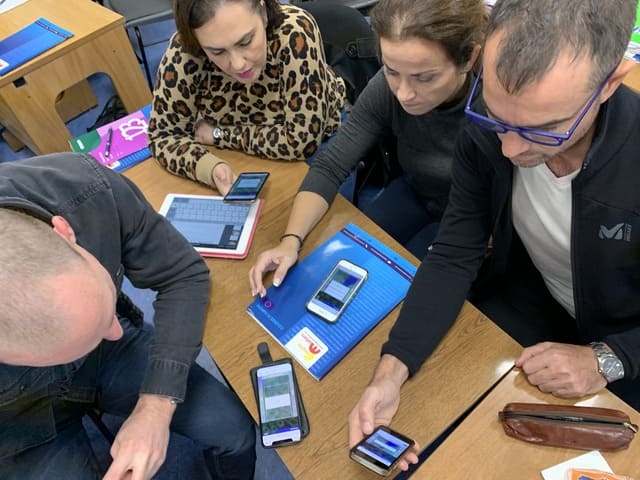
Adopting new digital tools can feel overwhelming when you are trying to manage a full timetable. Reading blogs is a wonderful starting point, but true confidence comes from hands-on training alongside trainers who understand the daily realities of school life and colleagues who share their perspectives and ideas.
This is where English Matters can help you get ahead. As a leading provider of European teacher training, we offer dedicated Erasmus+ courses specifically designed around Artificial Intelligence in education. The structured programmes bridge complex technologies to practical classroom use, giving you practical, ethical, and highly effective ways to use AI tools in your specific subject area.