









With bilingual and multilingual education expanding rapidly across Europe, many subject teachers are required to address a fundamental question: what is CLIL methodology and how can it be implemented successfully?
CLIL – an acronym for Content and Language Integrated Learning – is a dual-focused educational approach where a non-language subject (such as science, history, geography, or art) is taught through the medium of a foreign language (usually English). Rather than teaching language in isolation, CLIL uses subject content as the context for language acquisition, allowing pupils to learn both simultaneously.
The Core Pillars: The 4 Cs of CLIL
To understand what CLIL methodology is, one might start by examining the foundational framework developed by educational linguist Do Coyle. A successful CLIL lesson must integrate four interconnected dimensions known as the 4 Cs:
- Content: The core subject knowledge, skills, and understanding (e.g., teaching the water cycle or the Roman Empire).
- Communication: Learning to use language for learning and through learning, focusing on functional vocabulary rather than abstract grammar rules.
- Cognition: Challenging pupils intellectually using Higher-Order Thinking Skills (HOTS)—such as analysing, evaluating, and creating—rather than simple memorisation.
- Culture: Exposing pupils to alternative perspectives and international dimensions related to the topic.
Essential Scaffolding Techniques for Non-Language Teachers
One of the biggest anxieties for subject teachers entering a CLIL classroom is that pupils might struggle to grasp complex concepts due to language barriers. The key to overcoming this challenge is scaffolding—providing temporary supportive structures that aid understanding.
Scaffolding is not exclusive to CLIL, although it plays a particularly important role within this approach. It refers to the strategies, resources, and forms of guidance that teachers use across subject areas to support learners in accessing challenging content and developing their understanding. The support is gradually withdrawn as learners become more capable of completing tasks independently.
| Scaffolding Tool | Practical Application in Class | Pedagogical Benefit |
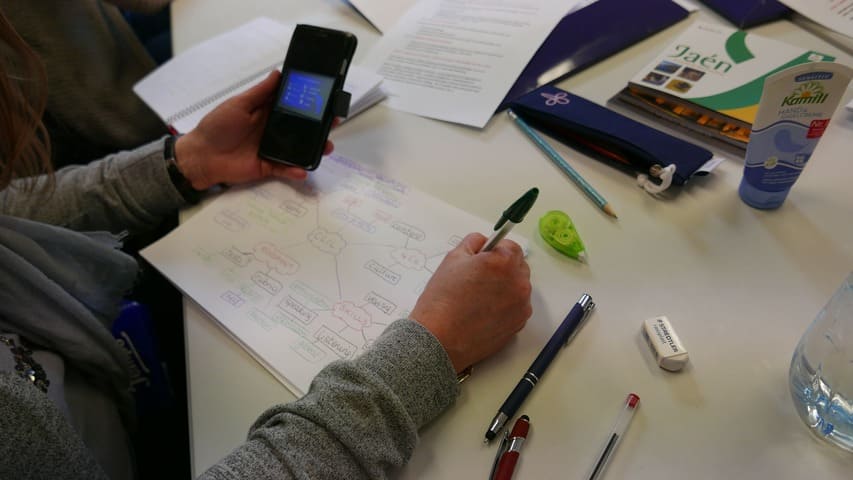
| Visual Organisers | Use flowcharts, Venn diagrams, and mind maps | Reduces reliance on dense text; highlights relationships between ideas |
| Word Walls & Banks | Display key topic vocabulary with visual cues on the wall | Provides instant lexical support during written or spoken tasks |
| Sentence Starters | Provide frames like “In my opinion, the main cause was…” | Helps pupils articulate complex thoughts in a foreign language |
| Bilingual Glossaries | Offer key terms translated into the mother tongue | Ensures core academic concepts are not misunderstood |
Moving Beyond Grammar: Language FOR, OF, and THROUGH Learning
In a traditional English language class, the focus is on grammatical structures (such as the present perfect or passive voice). In contrast, when applying CLIL methodology, language is categorised functionally:
- Language OF Learning: The essential topic-specific vocabulary (e.g., evaporation, condensation, precipitation).
- Language FOR Learning: The operational language needed to work in the classroom (e.g., “Can you pass the test tube?”, “We agree because…”).
- Language THROUGH Learning: Spontaneous language that emerges during active problem-solving and teacher feedback.
This means that students may encounter and be expected to understand and use complex grammatical structures in meaningful contexts before they have developed an explicit understanding of the grammatical rules governing them. CLIL provides opportunities for learners to develop their grammatical competence through engagement with subject content and purposeful communication.
Upgrade Your CLIL Teaching Practice with English Matters
Teaching your subject in a second language can feel daunting, whether you are a science specialist worried about your English fluency or an English teacher taking on humanities modules.
If you want to master CLIL methodology through proven, practical techniques, English Matters provides the ultimate solution. Our acclaimed Erasmus+ training course, CLIL Methodology: Content and Language Integrated Learning, is specifically designed for primary and secondary teachers across Europe.
Held in culturally rich European settings, the course delivers practical scaffolding strategies, lesson design frameworks, and interactive workshops led by CLIL experts. By participating in an English Matters mobility, you will gain the skills, resources, and international network needed to deliver engaging bilingual lessons with absolute confidence.